12/March/2015
I had four days to kill in Rishikesh before the start of a trek up in the snowy hills. On that particular day, I decided to roam around a bit on foot and explore Maharishi Mahesh Yogi's abandoned ashram more popularly known as The Beatles' Ashram because of its one-time residents who were here in the late 60s.
I crossed the narrow Ram Jhula (jhula = swing), an iron suspension bridge over the River Ganga, and took a right turn, walking past the Geeta Bhavans, the Paramarth Niketan and other ashrams, and 100s of stores selling anything ranging from food, yoga, and massage, to pilgrimware, music CDs, and enlightenment.


And I said “Well, if you’re so cosmic, you will know why. …. He said “I don’t know why, you must tell me” And I kept saying “You know why” –and he gave me a look like, “I’ll kill you bastard.” ]
*Maharishi was also known as the laughing guru because of his giggles.
No one knows the truth of those accusations, but decades later Harrison and McCartney did patch up with Maharishi after they were convinced that he was innocent. Maharishi left India for Switzerland and then to Italy and Austria before settling in the Netherlands. The government took over the Ashram land in the early eighties after a legal battle and included it in the Rajaji National Park, downing shutters on one hell of an era.
All said, this post is not exactly about the Mahirishi or the band or even the structures left untended, overgrown by weeds, trees, and creepers. Or maybe, it is about all of it and a little bit more.
 The sign in Hindi said “Aam aadmi ka pravesh varjith hain” - transliterated as "entry banned for the common man". Entering the place is not easy, as in speak “friend”
and enter, but it is not difficult either. Cough,
cough.
The sign in Hindi said “Aam aadmi ka pravesh varjith hain” - transliterated as "entry banned for the common man". Entering the place is not easy, as in speak “friend”
and enter, but it is not difficult either. Cough,
cough.
I’m not aam aadmi anyway! ;)


 I took the stairs with the imaginary railings to get to the first floor…

 *This dome (number 9) is where Lennon meditated, if the stories are to be believed.
The domes were all over the place. Almost all of them had serial numbers on their entrances. I saw one that was marked 75. I’m sure there are a lot more of them. Apparently, these are also referred to as "magic eggs." Meditating inside one of these eggs is supposed to take you to higher realms without the support of chemicals. Chemicals were something The Beatles too were keen to move away from.


 The following three pics are parts of a single work on a long wall. I did not have enough room to get a single long shot.


 Imagine with a typo, couldn't let it go!


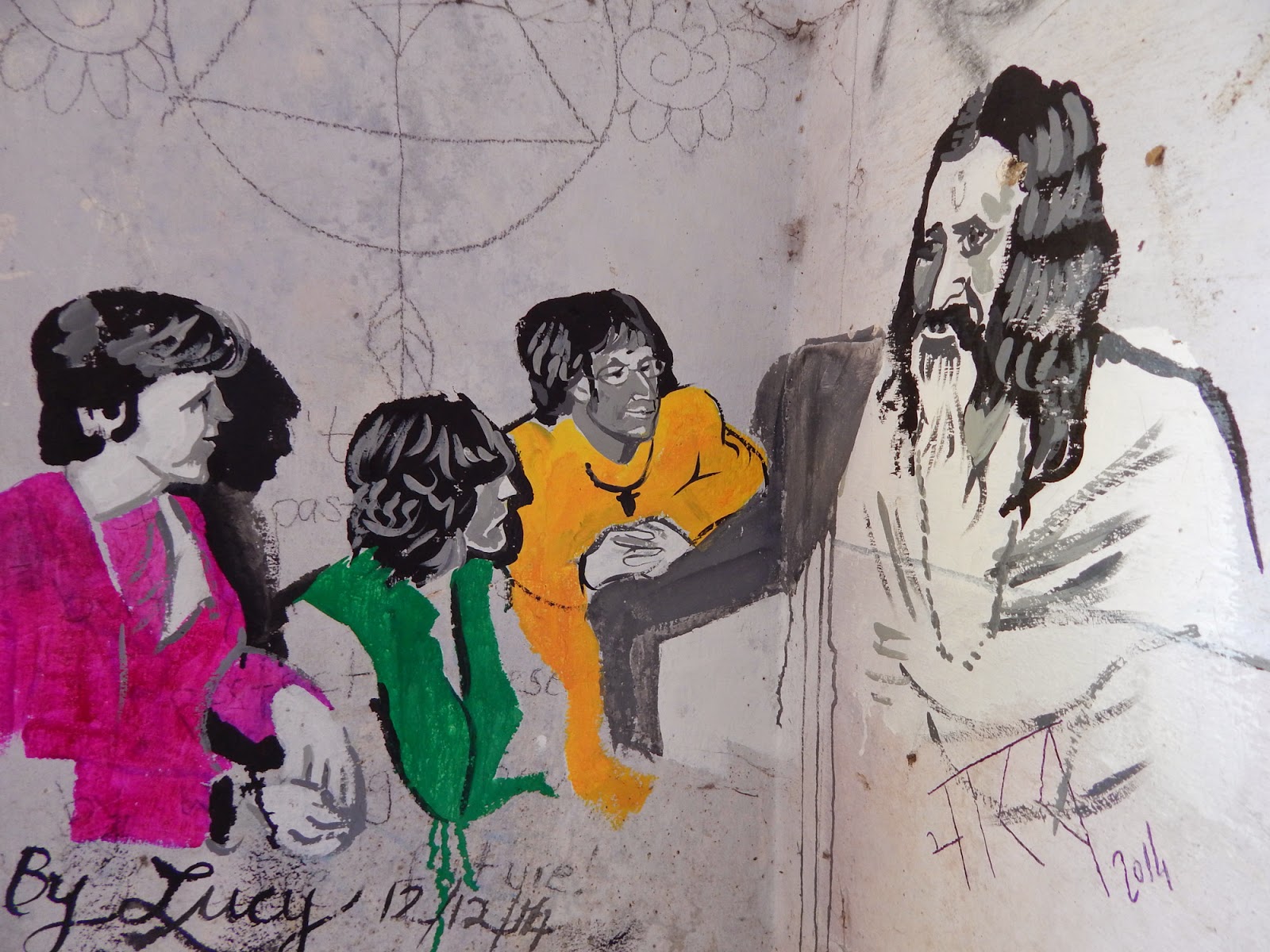
 Fab Four!


 Sell peace like soap!


 Sarah was the person who turned around and looked when I swore as I entered the Cathedral. This Canadian is one of the artists making this place a fountainhead of music, peace, and love. Sarah at work!
 Here's a brief story of the Cathedral. All the names
mentioned in this lovely message rang a bell. Except Pan Trinity Das. Strange name. I
made a mental note to google him or her out, but forgot to do it that night.
Here's a brief story of the Cathedral. All the names
mentioned in this lovely message rang a bell. Except Pan Trinity Das. Strange name. I
made a mental note to google him or her out, but forgot to do it that night.
 After getting out of the cathedral, I walked a little bit and came across this structure which looked like a hybrid of a Ziggurat and something else I'm yet to put a finger on. This building with four floors was a focal point of the ashram when it was alive.
 I walked into each of its rooms, most of which housed a delightful reward or two.


 The long corridor. The construction, quite literally, is way out of civil engineering books.


Hmmm.



On the terrace, there were these huge "eggs," which served as water tanks in the past!


 These structures look like the relics of another civilization; definitely not the construction style of the second half of the twentieth century (even for an ashram).
 I do have a sharper version of the pic below, but this is much more fun!


 Particularly reassuring. :)

 A locked rusty gate announced the end of the adventure for the day.Or did it?

While walking back, I noticed a curious structure behind the second ziggurat and decided to take a closer look.

Two stone paved paths diverged from a cairn.


Near the entrance of the hall, both to the left and right, I noticed passageways. I took the one on the left and noticed that the temperature dipped by a few degrees as soon as I got inside it.
 On either side of this passage, there were numerous small rooms with just enough space for a person to lie down or may be sit and meditate. Weird shape. In any place other than this, I would have thought of these enclosures as solitary torture chambers.


 Having
had my fill, I made a slow exit, making it a point to tell some people
that I met (who seemed confused by the sheer scale of the place), where they could hunt for thrills.
Having
had my fill, I made a slow exit, making it a point to tell some people
that I met (who seemed confused by the sheer scale of the place), where they could hunt for thrills.
On the way out, I did come across a few more delights (some scatological, some others).
I think the reference here is to Ringo’s departure after ten days of stay at the Ashram complaining that he cannot handle spicy food.

 Happiness is a warm gun...


Paul’s emergency lyrics cupboard.
 The last letter in this postbox that stands near the entrance must have been dropped in 1980 or so, 35 years ago.

After that day, I had many conversations about the ashram...some said that it should be made into a monument and be preserved by the government. I disagree. It's good the way it is. No government preservation can tap into the collective spirit and the creativity energy that you find in this place now. And if the creepers claim it completely before the free spirits, so be it.
Finding Tona and Pan (Two days later)
14/March/2015
It was evening. I walked down to the Laxman Jhula to see what was happening at the International Street Art Festival. I asked around for Tona, but the first few artists that I met did not seem to know him or his whereabouts.
I had four days to kill in Rishikesh before the start of a trek up in the snowy hills. On that particular day, I decided to roam around a bit on foot and explore Maharishi Mahesh Yogi's abandoned ashram more popularly known as The Beatles' Ashram because of its one-time residents who were here in the late 60s.
I crossed the narrow Ram Jhula (jhula = swing), an iron suspension bridge over the River Ganga, and took a right turn, walking past the Geeta Bhavans, the Paramarth Niketan and other ashrams, and 100s of stores selling anything ranging from food, yoga, and massage, to pilgrimware, music CDs, and enlightenment.
After a kilometer or so, the dirt road veered to the left, just
after the Last Chance café – an inexpensive lodge with 5 rooms and ten dormitory beds, "good vibrations," and a guitarist who sat strumming in a corner to complete the Bohemian picture.
I walked in and said hello to Manjeet, the owner of the joint, who I knew through
a common friend. He told me to not give any money to get into the “Beatles”
Ashram but to use his name as reference. I agreed, thanked him and moved ahead.
A little while later I found myself staring at the dilapidated buildings of the Beatles' Ashram from outside the walls of the compound.
The backdrop
In the winter of 1968, the Beatles quartet stayed at the ashram along with the Beach Boys, Mia Farrow, and a whole lot of heavyweights, practicing transcendental meditation with Maharishi Mahesh Yogi. The stay here led The Beetles to write dozens of songs that were featured in their White Album. Their stay also signaled the lighting of the beacons of Rishikesh to hippies from every nook and corner of the world.
In the winter of 1968, the Beatles quartet stayed at the ashram along with the Beach Boys, Mia Farrow, and a whole lot of heavyweights, practicing transcendental meditation with Maharishi Mahesh Yogi. The stay here led The Beetles to write dozens of songs that were featured in their White Album. Their stay also signaled the lighting of the beacons of Rishikesh to hippies from every nook and corner of the world.
The Beatles' affair with Rishikesh and their Guru did not last longer than a few weeks
and the band publicly denounced the Maharishi in London, three months down the
line. The break-up was sparked by rumors of Maharishi’s sexual advances
towards a woman. Lennon recounted later in the book “Lennon Remembers”
[So we went to see the Maharishi, the whole gang of us the next day charged down to his hut, his very rich-looking bungalow in the mountains. And I was the spokesperson–as usual, when the dirty work came, I actually had to be leader, whatever the scene was, when it came to the nitty gritty I had to do the speaking. And I said, “We’re leaving.”
“Why” Hee-hee* all that shit.
[So we went to see the Maharishi, the whole gang of us the next day charged down to his hut, his very rich-looking bungalow in the mountains. And I was the spokesperson–as usual, when the dirty work came, I actually had to be leader, whatever the scene was, when it came to the nitty gritty I had to do the speaking. And I said, “We’re leaving.”
“Why” Hee-hee* all that shit.
And I said “Well, if you’re so cosmic, you will know why. …. He said “I don’t know why, you must tell me” And I kept saying “You know why” –and he gave me a look like, “I’ll kill you bastard.” ]
*Maharishi was also known as the laughing guru because of his giggles.
No one knows the truth of those accusations, but decades later Harrison and McCartney did patch up with Maharishi after they were convinced that he was innocent. Maharishi left India for Switzerland and then to Italy and Austria before settling in the Netherlands. The government took over the Ashram land in the early eighties after a legal battle and included it in the Rajaji National Park, downing shutters on one hell of an era.
All said, this post is not exactly about the Mahirishi or the band or even the structures left untended, overgrown by weeds, trees, and creepers. Or maybe, it is about all of it and a little bit more.
The Body
There was a security staff sitting behind the locked entrance with a sign that says entry is not permitted.
There was a security staff sitting behind the locked entrance with a sign that says entry is not permitted.
The sign in Hindi said “Aam aadmi ka pravesh varjith hain” - transliterated as "entry banned for the common man". Entering the place is not easy, as in speak “friend”
and enter, but it is not difficult either. Cough,
cough. I’m not aam aadmi anyway! ;)
Once inside, I walked walk up the winding
concrete path lined with a few cement benches and rather unique looking dome structures before reaching the main gate of
the Ashram.
After crossing the main gate, I entered the first dome structure (numbered 9*) on the right. These self-contained meditation houses lined with stones on their exterior, have two floors, a
staircase, and a toilet.
I should have known the writing on the wall by this time, but I did not.
I should have known the writing on the wall by this time, but I did not.
...and one
look at the artwork on the interior of the dome and I was bowled over.
The domes were all over the place. Almost all of them had serial numbers on their entrances. I saw one that was marked 75. I’m sure there are a lot more of them. Apparently, these are also referred to as "magic eggs." Meditating inside one of these eggs is supposed to take you to higher realms without the support of chemicals. Chemicals were something The Beatles too were keen to move away from.
Having seen enough of the stone covered domes engulfed by the forest, I walked to the main building that I had seen from the entrance. That one is a beauty with enough fan labor in the rooms on the first floor and above that will take you hours to
appreciate. Check these out.
This is one of my favorites because of its simplicity.
And then, you come across the handiwork of unimaginative people just writing their names without even the faintest thought of a message. Like this crap below.
Look what you've done
You made a fool out of someone

You would also want to punch some faces - belonging to those who scribble their names in the middle of a classic piece. I'm sure these are the types who shit in the center of their dining tables at home when everyone is about to eat.
Anyway, after spending a lot of time in the main building, I decided to explore the left wing of the ashram.


Look what you've done
You made a fool out of someone
You would also want to punch some faces - belonging to those who scribble their names in the middle of a classic piece. I'm sure these are the types who shit in the center of their dining tables at home when everyone is about to eat.
Anyway, after spending a lot of time in the main building, I decided to explore the left wing of the ashram.
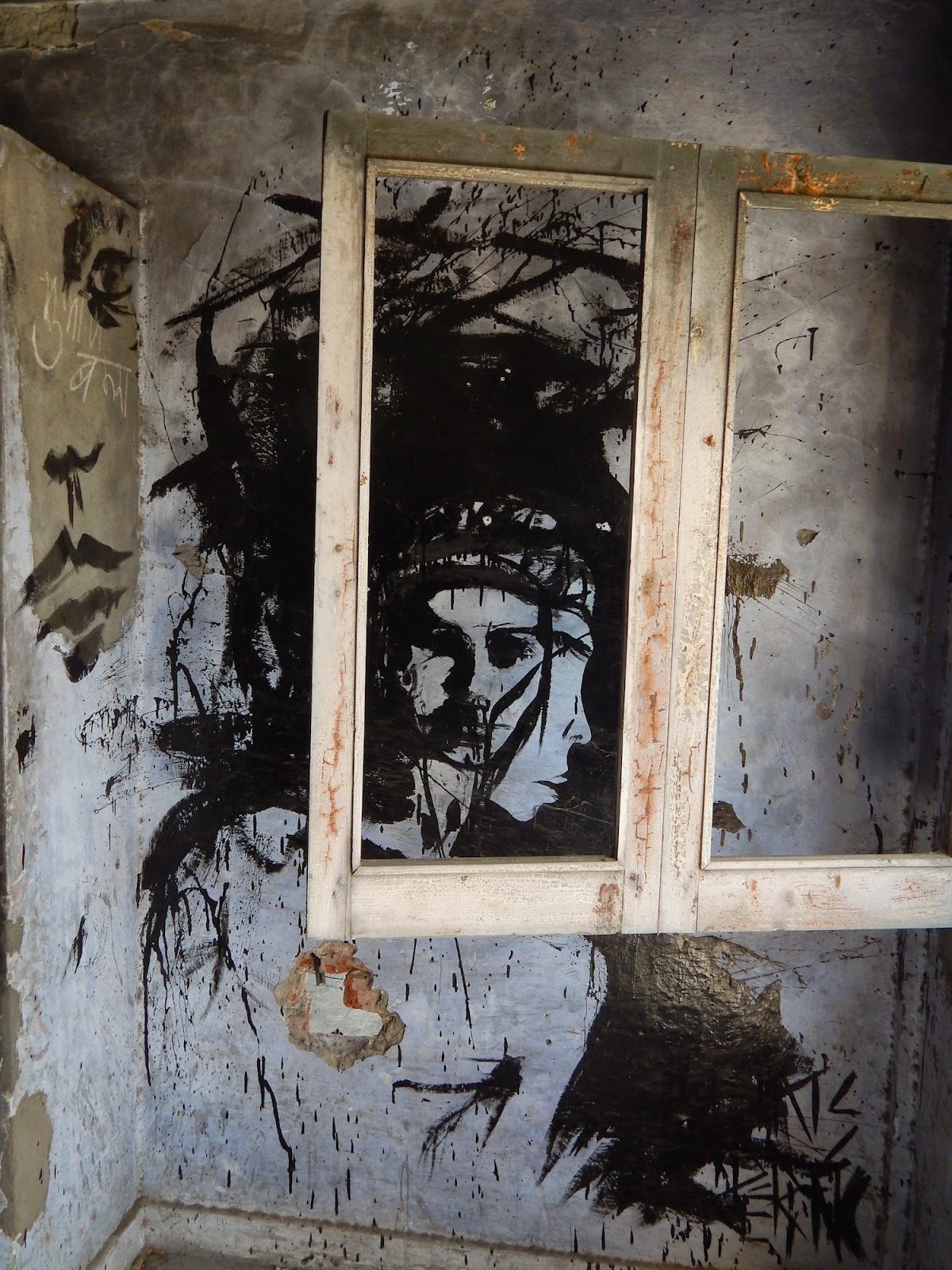
Gutted or not, art was everywhere.
I wonder who built this staircase. One person can barely walk up this one (and I am not bulky). 
After walking past the Shivling and the gutted building, through an outgrowth of trees and shrubs, I saw some glimmer of promise.
...and walked into The Beatles Cathedral Gallery. See for yourself!


 I entered the gallery which must have been a prayer hall of sorts decades ago. The silence of the place was broken by my loud "Holy Shit" - thrice to no one in particular as I stood amazed by the sheer magnetism of the transformed hall. I sensed some movement and looked around to see a lady sitting on the floor of the stage looking back at the source of the sound. I
mumbled something like "sorry, this just is sooo cool" and turned my attention to the art around.
I entered the gallery which must have been a prayer hall of sorts decades ago. The silence of the place was broken by my loud "Holy Shit" - thrice to no one in particular as I stood amazed by the sheer magnetism of the transformed hall. I sensed some movement and looked around to see a lady sitting on the floor of the stage looking back at the source of the sound. I
mumbled something like "sorry, this just is sooo cool" and turned my attention to the art around.
Hmmm.
I walked up to the terrace and realized that there are two of these ziggurats, the one behind slightly taller than the first. The terrace also gives you a nice view of the Rishikesh skyline.
On the terrace, there were these huge "eggs," which served as water tanks in the past!
Having explored as much of the two buildings as possible within the time, I walked out. Here's a view from the side, so you get an idea of its architecture.
 And finally, a better shot from behind the building, from near the edge of the ashram perimeter.
A locked rusty gate announced the end of the adventure for the day.Or did it?While walking back, I noticed a curious structure behind the second ziggurat and decided to take a closer look.
Two stone paved paths diverged from a cairn.
I took the path to the left and soon found myself at another prayer hall, one in a much worse shape than the cathedral.
Near the entrance of the hall, both to the left and right, I noticed passageways. I took the one on the left and noticed that the temperature dipped by a few degrees as soon as I got inside it.
The passage on the right side was similar in architecture, but was paved with stones. This ashram must have used up the bulk of the pebbles and round stones in the river when it was being built.

Interior of the spaces on the right.
It was a network of passages which branched away from a T-junction at the end. I did not venture further since it was dark inside the "tunnels" - Yes, I am ophiophobic, like a lot of people!
Under whatever powers vested in me, I hereby name this place, The Lair of The Balrog. :)
Under whatever powers vested in me, I hereby name this place, The Lair of The Balrog. :)
On the way out, I did come across a few more delights (some scatological, some others).
I think the reference here is to Ringo’s departure after ten days of stay at the Ashram complaining that he cannot handle spicy food.
After that day, I had many conversations about the ashram...some said that it should be made into a monument and be preserved by the government. I disagree. It's good the way it is. No government preservation can tap into the collective spirit and the creativity energy that you find in this place now. And if the creepers claim it completely before the free spirits, so be it.
Finding Tona and Pan (Two days later)
14/March/2015
It was evening. I walked down to the Laxman Jhula to see what was happening at the International Street Art Festival. I asked around for Tona, but the first few artists that I met did not seem to know him or his whereabouts.

Then I stumbled upon someone about to start his work near the Jhula and here’s how the conversation went.
……
Pan: Yeah, Tona is is painting the police station near the Jhula.Me: What??? But I thought he painted the police station two days ago.Pan: Yeah, but he is painting a bigger one this time.Me: Really? He’s crazy! I’ll go check it out. Btw, good luck with your work. Where are you from?Pan: From Canada, but settled in the US. My wife is also part of this.
Me: From Canada? Is her name Sarah? (Silly, but yes, she was the only Canadian artist in Rishikesh that I had met.)
Pan: No, not Sarah. Sarah is actually part of the Beatles Cathedral Gallery Project.
Me: I know. I was there at the Cathedral two days ago. Truly awesome work!
Pan: Thank you, it is actually my project.
Me: Shitttttttttt! Seriously? Can I take your picture?
Pan: Sure! [Click] Btw, we are reworking the Cathedral in a few days, after this festival is over. So what you saw this week will become the “before” piece.
……
And, in his sticker was printed #ARTBYPANTRINITYDAS. Here's a picture of Pan Trinity Das, the man I wanted to google but ended up meeting on the streets of Rishikesh.

I promised to visit the cathedral after my trek got over to get the “after” piece; and moved on in search of Tona and his street art.
Hey..wait a minute…Who is Tona? Watch this space.