Pages

Friday, November 28, 2014

#Spicejet, to CEO Sanjiv Kapoor and all the puny consumers

This is a short and bitter story of how consumers get taken for a ride by airlines in India - in this case, Spicejet. Here's what happened.

Three of us booked the tickets in August for a trek in December - yes, planned well in advance, and booked through Cleartrip.com*. Bangalore-Delhi-Dehradun and back. We were part of a bigger group of 12 people. Another person in the group booked the same flight a few days later at a much steeper price (just to travel together) Here's the ticket. 

A few days left to go, and I received this text. Nothing alarming, just the timing of the return flight got changed a bit.

Dear SpiceJet customer (PNR-HY89TQ): Your flight SG 2326/SG 509 dated 14-Dec-14 from Dehradun to Bengaluru has been changed to SG 2326/SG 223 due to the introduction of our new winter schedule and will be operating via Delhi with the revised departure time of 04.35 PM and the revised arrival time of 10.15 PM. We regret the inconvenience caused. Please check the flight status at http://book.spicejet.com/FlightStatus.aspx or call +919871803333 / +919654003333, if you have any queries or concerns.


Great, new winter schedule. Now that may not be childish as an excuse, but it did sound rather off. Would you not be planning for winter schedules in advance, I mean you're a freaking travel company, right?


The message was not bad, we were arriving 25 minutes early on our return leg. Anyway, I decided to check the link to see what was happening. This is what is possible on their web site. The flight date is a mandatory field which will give you just 4 options - 4 days: day before yesterday, yesterday, today, and tomorrow. Now, airlines may have their reasons for doing so, but why sent me there in the first place, if you know in advance, that I will not be able to check the flight status? 


So I decided to call the numbers they provided. I hung up after 7 minutes of listening to shitty music. I did wonder, how people could panic, if the issue was much graver than arriving a few minutes early. I need not have wondered because 2 days later the opportunity came alive for me....with this SMS.

Dear SpiceJet customer (PNR-TBYKJA): Your flight SG 2327 dated 06-Dec-14 from Delhi to Dehradun has been changed to SG 2325 with a revised departure time of 03.05 PM due to operational reasons. We regret the incovenience caused. Please check the flight status at http://book.spicejet.com/FlightStatus.aspx or call +919871803333 / +919654003333, if you have any queries or concerns.

Just great! Operational reasons. The excuses start becoming realistic. 

In effect, on our onward journey we would reach Delhi airport at 9.15 (after waking up at 3 in the morning for our 6.30 flight from BLR) and will have to heat our heels in the airport for 6 hours. I mailed my friends saying I'm checking some options near Delhi airport to keep us occupied for those hours. I mean it's just not done, the rest of our party will be having fun in Rishikesh while we waste away at the airport or around there. I was typing out a joke about how our party in Delhi in those six hours would rival the frolic in Rishikesh, when this e-mail arrived like a bolt from digital ether. 


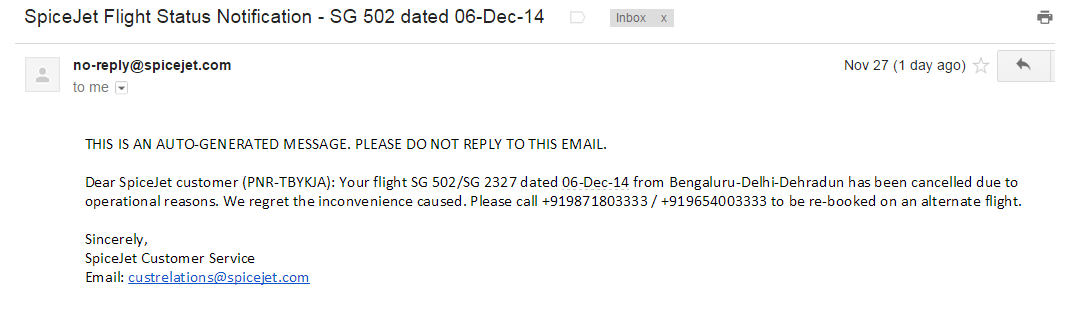
I was like whaaaaat? The entire flight from BLR to Delhi and Delhi to Dehradun is cancelled due to operational reasons? Please do not reply to this freaking mail? Please call to be booked on an alternate flight so that I can listen to your alkaline music? 

Like anyone else, I freaked out and called the other four people to salvage our vacation in the mountains. A week left for the trip meant that rates had shot up. One way to Dehradun was costing around 20 grand per head. In the end, we booked a steep fare to Delhi and decided to take a cab to Rishikesh. We could not cancel the trip, because 8 people will already be there. And that got me thinking, what about the others? The families who booked tickets, the international travelers, just about anyone else. What if I could not afford to rebook? And there is not one word about refund in that mail. Is there no f*cking accountability? Am I just a PNR number for you, that you can toss around at will and I adjust accordingly? 

Background: Spicejet has been in financial trouble for a while. The company has been in the red for a while, with pilots quitting and what not. Questions had been raised of late of it's ability to be a "going concern". Mr. Raghuram Rajan (RBI) said a few days back that some of the so-called industry-captains are anything but that, and more like people who chew on the public (he was more polite). 

My worry is this. How do we allow this in this country? This airline announced the best deals all the way till 2015 (I think so, Spicejet, you cannot sue me for this) and mopped up public money. Only to leave us in the dark for winter schedules or operational reasons? You see it right? - Cash flow issues, so what do we do, Mr. CXO? Announce discounts for services to be performed in the future, collect money from toothless consumers, give excuses, cancel flights, and give it up their arse, without even thanking them. 

The Marans of the world (Sun Group) are out of power in both the state and the center. Is that contributing to this, I speculate.  


Verdict: Please ditch this airline. As for us, I'm keeping my fingers crossed about this return journey from Dehradun to Bangalore. You know my worst fear these days? An SMS from Spicejet that says, 

Dear PNR, your return flight from Dehradun to Bangalore has been cancelled coz we messed up, royally, like Kingfisher. You saw it coming, din't you? You can call us for awesome music. By the time you see this text after your awesome vacation outside mobile coverage, you will be totally screwed. Awww, poor, poor PNR. Call us if you have to rebook or you could log on to takeyourtrip.com.*

*Makemytrip.com or Cleartrip.com have not been hurt while writing this post.

Thursday, November 13, 2014

Idiot’s Guide to Interstellar

The story in about 500 words: Earth is dying. Bunch of people go hunting for better locations through a wormhole near Saturn. Brave souls have gone before on reconnaissance missions and 3 habitable planets have been shortlisted. Planet 1 is a waterworld, and does not work. Planet 2 is screwed up because Matt Damon, the perennial data fudger, went there first.  With no fuel left for the roundtrip to earth, the hero jumps into a black hole with his robot, leaving Anne Hathaway to sling away gravitationally to check out on her boyfriend in Planet 3. And the rest is history. (There is a family undercurrent, but I will let that pass.)


Interstellar is not a physicist’s wet dream as a lot of people would like to make it sound. And no, you don’t have to know too much science to depreciate it. Just let your imagination run a bit wild.  Here’s all the ammo you need:

Wormhole: A thingie that lets you travel far without travelling far. Sort of like a trapdoor in the universe.

Black Hole: A celestial body which performs a function quite opposite to that of a rectum that most non-physicists know of. This one sucks up everything with its gravitational pull, including light. In the movie, we have a “gentle” gargantuan black hole, so that we can avoid a tragic ending. 

Event Horizon: Tipping point associated with a black hole. There no going back once you have crossed it – more like the edge of a cliff. 

Gravity: Duh

Time: What the clock shows. Time is not a constant as we know it. In different parts of the universe, time moves at a different “rate”. Like an hour in “Waterworld” equals seven years in Tibet or any other place on Earth. As in, I could spend an hour there and come back to see my son in High School. Nolan’s fascination with time effects did not end with Inception, apparently.

Drones: Flying pilotless vehicles used to bomb suspected terrorists these days. They feature a drone in the first half – zero impact on the movie. Don’t drones heat up while flying in the air? I dunno, coz people touch it after it lands. And yes, it’s an Indian drone (maybe that’s why) which was being controlled by Delhi Mission Control before they lost control.

Plan A/Plan B: As the names indicate, these are strategic management initiatives to save the world. Not much impact on the storyline, though they like to keep you guessing. 

They = Us.

Love: We know this concept, but its power is less understood, is all they’re saying.

Morse Code: Part of the back to basics campaign. Dots and dashes do script an impossible turnaround.

BTW, except for the farm (thank God, Murph burnt it down) and the township, there are no visuals of any other parts of dying earth, even for some visual effects. Christ, the Redeemer or the Pyramids would have looked good with the dust storms and all. That said, I wonder what was happening in the Middle East at that point.

As an aside, look out for the number of times “Do not go gentle into that good night” and “Save the World” are repeated.


Verdict: Did I enjoy it? Not exactly. I was waiting for some magical touch, which never came. No grandiosity, no visual spectacle, and don't get me started about the pathetic screenplay. Watch it, because you will sound uncool otherwise. I will not prefer a second sitting. At around 3 hours, Interstellar is boring in a lot of places, and could use some heavy editing – around 55%. 


At the risk of re-meming:


PS: Un-pixellated video streaming through a wormhole. My foot. I'm no wormhole expert. But that's just not done. And that Romilly guy was there alone on that spaceship for 23 Goddamn years. I hope he had access to some nice stuff. 

Wednesday, August 20, 2014

An evening in Gangar, a remote Himalayan Village (also Part 3 of our HKD trek)


There are places and people that you eye with a shade of undisguised envy while passing through. One such place was Gangar - one of the most beautiful villages I have ever come across - colorful trees, a river flowing by the side, a mountain backdrop, wooden buildings, terrace farms, everything that could fit into a postcard. We had seen this village on our way to Har Ki Dun valley. Thankfully, on our return leg, we camped near the village, and had the energy reserves to walk around the place.


This a neat little bridge with the sheen of newly polished wood, connecting the village to the trekking route and the rest of the world, set over the nascent blue waters of the Har Ki Dun Gaad (River).


The dormant engineer in me got a wake-up call while looking at the basic structure. This bridge was rebuilt recently, but the underlying architecture is more than a few decades old. Just look at those long wooden rivets! (I hope those are indeed rivets. My engineering knowledge, for the lack of a better word, sucks.) 


Here's proof that I crossed the Rubicon. I wonder why I was wearing that jacket though.

Another bridge on the trek route, a few kilometers away. I was amazed at the simplicity and efficiency of these structures, built using locally available material like wood and rocks. This is also how the Gangar bridge might have looked, before the renovation.

Engineering art at its basic best, a different sort of support mechanism.

A small mustard field at the entrance of the village. Now that's what I call landscaping!

We had to walk a bit to reach the center of the village. Some houses had micro mustard farms adjacent to them. Notice that the houses are also built with locally available material - stone slabs for roofing and wood for the structure.

Carpentry must be an in-demand profession here. There was a good amount of new construction and renovation happening. Loggerhead!

A typical Gangar house. The lower floor is taken up by the cattle.

The connection point to the rest of the world for a long time - the ubiquitous India Post.

People here build storage facilities like these, separate from their main houses.

The epicenter of the town - the village temple. All action happens in and around this place.


Another reason for me to repeat the word ubiquitous - cricket. The playground is by the side of the village temple. Can you spot the red tennis ball? 

We were invited into a house to have a taste of the local brew. (Double entendre intended) The hospitality of the place is to be experienced to be believed.


The streets of Gangar!

Men playing cards are a common sight in the Garwhal region (No, I am not going to repeat that ubiq.. word). Women tend to take up bulk of the household and even farm work. Flocks of goats and sheep form the bedrock of the Gangarian economy. Who takes care of them? Surprise! ....Women and kids.  
Scene in front of the temple. I call this cold play.

Community hall of sorts.

This is the temple of Someshwar Devta (more popularly known as King Duryodhan, the kickass/badass character from the Mahabharatha). This temple that worships a villain, in itself, represents the multitudes within the idea of our nationhood. Btw, back home in Kerala, we do have a temple in Malanada, dedicated to King D (also the sight of a horrific tragedy during a fireworks display 15-20 years ago).

Duryodhana is worshiped in some places in Uttarakhand, and legend has it that the mountain folk fought by his side during the Mahabharatha war. He is still their king and keeper - talk about the loyalty of mountain folks. Here's a link with some more interesting information regarding the choice of deity.

Motifs on top of the temple.

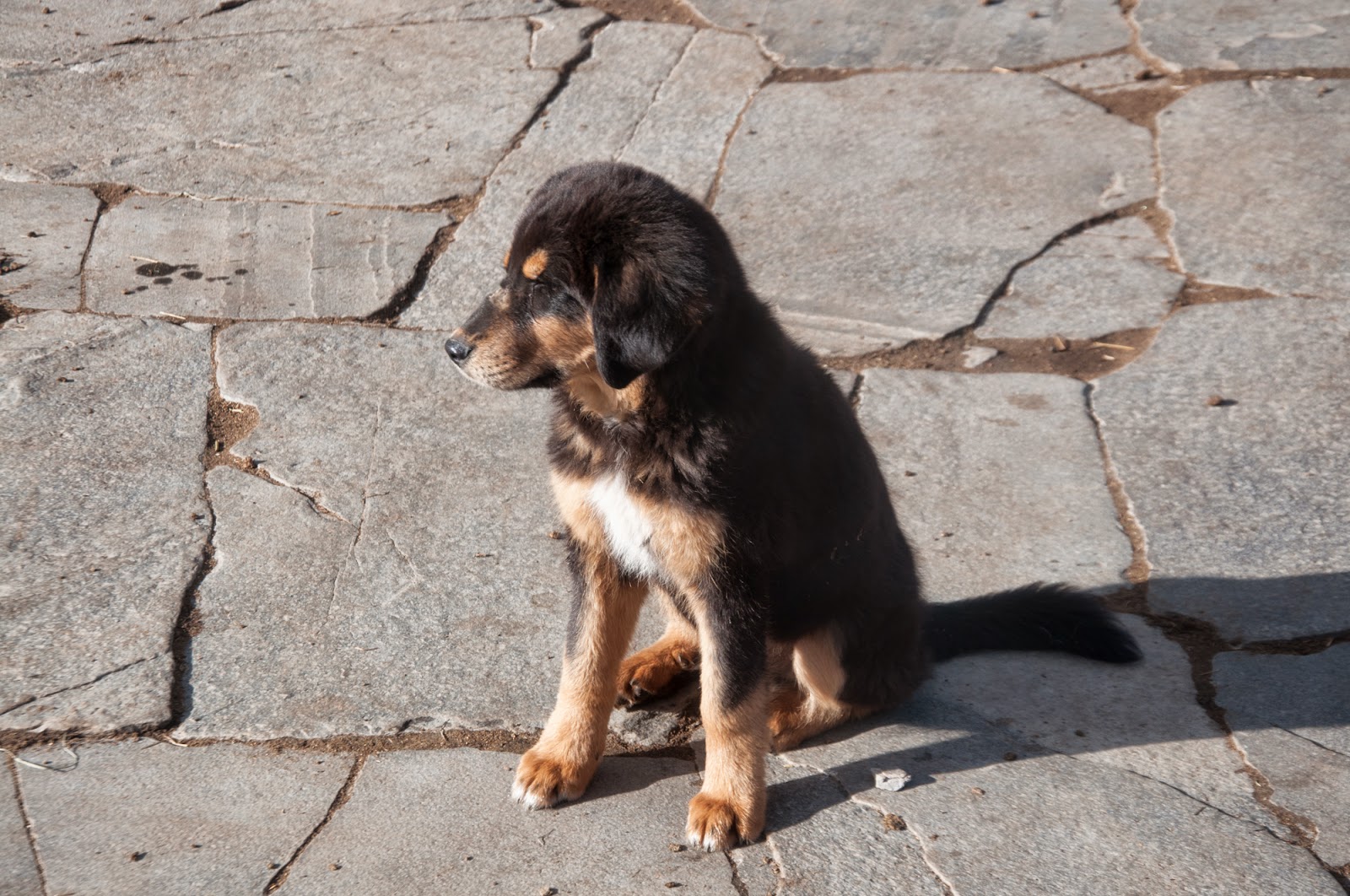
Two Bhotia dogs - two different moods.


Inside another house.

Biju wanted to buy some cloth that the locals use to make their sweaters. This material, available in black and grey, is made from wool, and is known to be more effective in resisting cold than some of the more modern materials. The granny in the pic above took us to her store/storage so that we could do some shopping.

In shopkeeper mode! Notice the artwork even in the storage structure.

Caught in action. 

Coming back to construction, a house like this costs the locals about 4-5 lakh rupees to build. I think the bulk of that would go into labor, as construction material is locally sourced with relative ease.  The wood used comes from deodar trees, available in the hills, and known for its ability to withstand dampness. (They are not selling, btw, as far as I know; in case anyone is rubbing their hands in glee (a) looking at undervalued assets or (b) hoping to live in a slice of paradise.)

The lower half of the house is reserved for livestock. Compare the basic efficiency of these rural construction ideas with the monstrosities masquerading as urban architectural brilliance.


A house being constructed.


Local real estate boom - a new one that's ready for a family to move in to. I cannot but help notice the metal roofing that's turning its back on tradition. That said, it might make better sense to have these (instead of stone slabs for roofs) in a seismic zone like the Himalayas.

We were amazed that they had managed to get this village connected using a satellite dish. All of us called our families from here after a gap of five days. The telephone booth is run by the village pradhaan (chief) who is seen waving us goodbye. He was an unabashed Modi fan, and told us that this time around, the entire village was going to vote for change. Voting had not happened by then, but his POV turned true when the results came out around 45 days later.

One last look from above. You can see our little tents in the far right corner of the picture.

A flour mill in front of the village in action.

The water flow that powers the mill.

Gangar was an amazing experience is simple living. That said, there were casualties (1) health care and (2) education. I have written about the absence of healthcare facilities in earlier parts of this trek blog.

Education is a tough proposition in the hills. Teachers who come to the village schools on deputation often leave quickly, unable to cope up with the weather and the absence of modern amenities. Gangar is a relatively better off village, and some of them solve the problem by sending their kids to nearby towns for schooling.

Teachers, btw, are pretty much treated like heroes here. We were told that in Gangar, the resident teacher does not even have to cook. He or she is considered a guest, and the villagers vie with one another to invite the teacher to their houses everyday to provide him/her the best that their kitchens have to offer. Hmmmm......now that gave me an interesting idea! While idling over a brew or two at the camp that night, I discussed the idea with my fellow trekkers. I should not have, because the idea just blew up inside the tent.

The villagers switched off their solar-powered lights by around 7.30. We partied outside our tents long after our trek support (trek support - I like that phrase) had gone to sleep. This was the last cold night for us for some time, and we were determined to extend it till we dropped.

---------------------------------------------------------------------

Next day, we moved on to Taluka. While waiting for our crew to arrive at Taluka, we spent some time at this shop drinking tea, eating omelets, and playing with these kids (including buying stuff from their shop and giving it to them). The older girl in the pic is Kajol and here she is playing bhooth (ghost) with her younger sister.

The younger one in a thoughtful mood. 

Kajol inspired my wife to do what I believe is one her best creations till date. (Notice that we are all stiff when it comes to posing for pics! :-)
On our way back, we saw some Gujjar huts. Gujjars are a nomadic population that survives on herding cattle. You might be able to make out the buffaloes in this pic.

I leave you with the image of a peacock with something up her derriere. This was at a Hotel in Purola, where we stayed on our way back to Dehradun.

The return journey was kind of eventful. Biju had booked a flight from Dehradun to BLR, while Randeep and I had booked a train. The train connecting us to Delhi (supposed to come in by around 11 in the night) was delayed by a few hours, which meant that we would miss the Delhi-Bangalore train. Randeep immediately booked a taxi to Delhi while I decided to act silly and book the flight for the next day (dreading the taxi ride as well as another two days in the train). Back in the Hotel, I tried to book the tickets and watched in horror as the rate climbed by 1,000 Rupees every time I tried to book. All said and done, my tickets were booked at a rate 30% higher than what I had seen on my phone while I was at the railway station. I went to sleep realizing how that peacock would have felt, had it been real.